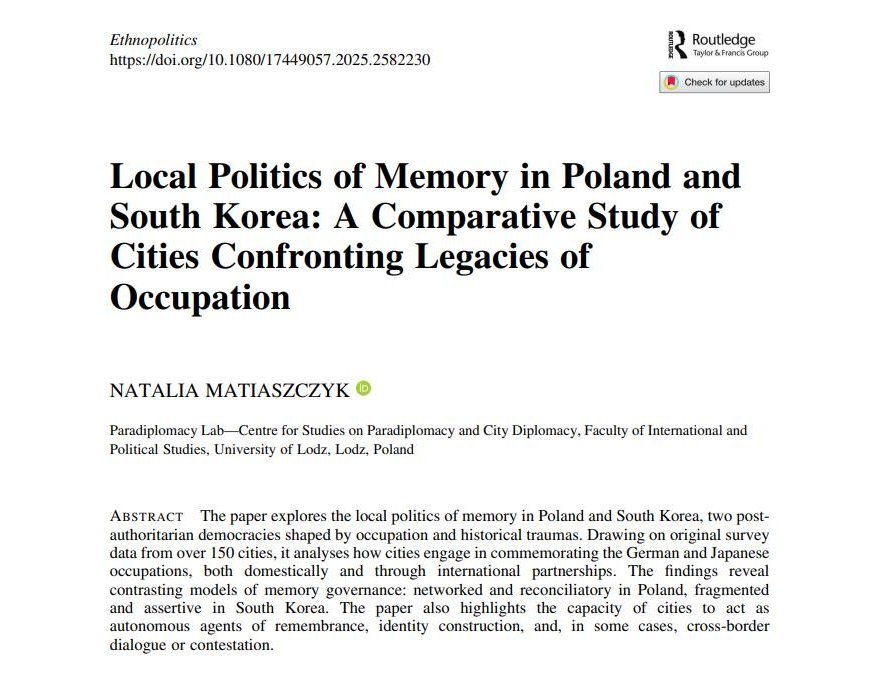
The paper explores local memory governance in two post-authoritarian democracies shaped by occupation and historical trauma. In the international dimension, Polish cities prioritize dialogue and joint commemorations with their German partner cities, promoting inclusive narratives of the wartime past. By contrast, South Korean cities more often adopt a confrontational stance toward their Japanese partners, favouring symbolic gestures that highlight national suffering.This publication offers one of the first large-scale comparative insights into how local governments shape transnational politics of memory.
The paper is available on the Ethnopolitics journal website at the following link: https://doi.org/10.1080/17449057.2025.2582230